Electrical glossary
139 electrical terms in plain English, from breakers to EV chargers. Every number links to its source.
No terms match. Try a shorter word.
A
- AFCI
- An AFCI is a breaker or outlet that detects dangerous arcing in wiring and shuts off the circuit before the arc can start a fire.
- Aluminum wiring
- Aluminum wiring is older branch-circuit wiring used in some homes from the mid 1960s. The CPSC warns of overheating at its connections.
- Ampacity
- Ampacity is the most current, in amps, that a wire can carry continuously without getting too hot.
- Amperage
- Amperage is the amount of electric current moving through a circuit, measured in amps. It sets how large breakers and wires must be.
- Arc fault
- An arc fault is an unintended spark across a break or damaged spot in wiring. It can reach thousands of degrees.
- Arcing
- Arcing is an electrical spark that jumps across a gap in a wire, connection or device and produces intense heat.
B
- Backfeed
- Backfeed is power flowing the wrong way, from a generator or other source back through house wiring and onto the utility lines.
- Ballast
- A ballast is a device that starts a fluorescent or HID lamp and limits the current flowing through it.
- Bonding
- Bonding joins metal parts so they stay at the same electrical level and can carry fault current safely.
- Breaker panel
- A breaker panel, often called a breaker box, is the metal box that holds a home's circuit breakers and sends power out to each circuit.
- Brownout
- A brownout is a partial drop in voltage that is not a full outage, so lights dim and motor-driven devices work less well.
- Burning smell
- A burning smell near an outlet, switch, panel or appliance is a warning sign of overheating that needs prompt attention.
- Bus bar
- A bus bar is a solid metal strip inside a panel that carries power from the incoming service to the breakers.
- Buzzing outlet
- A buzzing outlet is a receptacle or switch that hums, crackles or sizzles, which can mean a loose connection or arcing.
C
- Carbon monoxide detector
- A carbon monoxide detector senses CO gas and sounds an alarm before levels become dangerous, since people cannot see or smell the gas.
- Circuit breaker
- A circuit breaker is a switch that opens a circuit by itself when current gets too high. It can be reset once the cause is fixed.
- Clamping voltage
- Clamping voltage is the voltage level at which a surge protector starts to divert a surge. A lower number means it reacts sooner.
- Cloth-insulated wiring
- Cloth-insulated wiring is old building wire coated in rubber and wrapped in woven fabric, a covering that can dry out and crack with age.
- Code compliance
- Code compliance means electrical work follows the electrical codes that the state and city have adopted.
- Color temperature
- Color temperature describes how warm (yellow) or cool (blue) white light looks, and it is measured in kelvin.
- Conduit
- Conduit is a tube that holds and protects electrical wires. It can be metal or plastic and runs in walls, outdoors or underground.
- Copper wiring
- Copper is the standard conductor in home wiring. It carries current well and avoids the connection problems seen with older aluminum branch wiring.
- CRI
- CRI, the color rendering index, rates how true colors look under a light source compared with an ideal or natural light.
- CSST
- CSST is corrugated stainless steel tubing, a flexible gas line used inside many homes that can be damaged by lightning energy.
- CSST bonding
- CSST bonding is a wire connection that ties gas tubing to the home's electrical grounding system so lightning energy has a safe path.
D
- DC fast charger
- A DC fast charger sends direct current straight to the vehicle battery at high power, so it charges much faster than home Level 2 equipment.
- Dedicated circuit
- A dedicated circuit serves one appliance or device only, with its own breaker and wiring back to the panel.
- Demand load
- Demand load is the expected peak power use of a building. It is lower than the sum of everything that could be plugged in.
- Dimmer switch
- A dimmer switch is a wall control that sets how bright a light is, instead of only turning it on and off.
- Dimming lights
- Dimming lights get dimmer, often for a moment, when a large appliance starts or when a connection or supply problem lowers the voltage.
- Direct burial cable
- Direct burial cable is wire rated to go in the ground without conduit, such as Type UF-B cable.
- Dual-function breaker
- A dual-function breaker combines arc-fault and ground-fault protection in one breaker, so a single device guards a circuit against both hazards.
E
- Electrical inspection
- An electrical inspection is a city check of finished electrical work against the adopted code.
- Electrical panel
- The electrical panel is the main distribution point in a building. It takes power from the utility service and divides it into protected circuits.
- Electrical permit
- An electrical permit is approval from a city's building department to do electrical work, usually followed by an inspection.
- Emergency lighting
- Emergency lighting is backup lighting that turns on when normal power fails so people can see the way out.
- EMT
- EMT, or electrical metallic tubing, is lightweight steel conduit used to protect wiring, especially in commercial buildings.
- Equipment grounding conductor
- The equipment grounding conductor is the bare or green wire that links metal parts of equipment back to the panel to give a fault a safe path.
- ERCOT
- ERCOT is the Electric Reliability Council of Texas, the nonprofit that runs the grid serving most of the state.
- EVSE
- EVSE stands for electric vehicle supply equipment, the charging equipment that safely delivers power from a circuit to an electric vehicle.
- Exit sign
- An exit sign is an illuminated sign that marks the way to an exit so people can find it in smoke or darkness.
F
- Federal Pacific panel
- A Federal Pacific panel is an older electrical panel made by Federal Pacific Electric (FPE) that uses Stab-Lok breakers.
- Flickering lights
- Flickering lights blink or pulse in brightness, which can come from a loose bulb or a wiring problem in the circuit.
- Fuse box
- A fuse box is an older electrical panel that protects each circuit with a fuse, which must be replaced after it blows, instead of a breaker that resets.
G
- GFCI
- A GFCI (ground-fault circuit interrupter) shuts off power when it senses current leaking to ground, which protects people from electric shock.
- Ground fault
- A ground fault happens when current takes an unintended path to ground, such as through a metal box, a wire or a person.
- Ground rod
- A ground rod is a metal rod driven into the soil that connects a building's electrical system to the earth.
- Grounding
- Grounding connects an electrical system and its metal parts to the earth, so fault current has a safe path and voltage stays limited.
- Grounding electrode
- A grounding electrode is any object that makes a direct connection between the electrical system and the earth.
- Grounding electrode conductor
- The grounding electrode conductor is the wire that runs from the panel's ground connection to the ground rod or other electrode.
H
- Hardwired charger
- A hardwired charger connects directly to the circuit wiring with no plug and outlet, so the charger is fixed in place.
- Hardwired smoke alarm
- A hardwired smoke alarm is powered by the home's electrical system and has a backup battery that keeps it working during an outage.
- HID lighting
- HID lighting uses high intensity discharge lamps, such as metal halide and high pressure sodium, common in parking lots and large spaces.
- Hot outlet
- A hot outlet is a receptacle or cover plate that feels warm or hot to the touch, which can signal a loose connection or an overload.
- Hot wire
- A hot wire is a conductor that carries power from the source to a load. It is energized and can cause a severe shock.
I
- Interconnected alarms
- Interconnected alarms are linked smoke or CO alarms, by wire or radio signal, so that when one sounds, all of them sound.
J
- J1772
- J1772 is the standard plug used on most North American electric vehicles for AC charging at Level 1 and Level 2.
- Joule rating
- A joule rating shows how much surge energy a surge protector can absorb before it fails. A higher number generally means more capacity.
- Journeyman electrician
- A journeyman electrician holds the Texas license that sits below master electrician, earned with supervised training hours and an exam.
- Junction box
- A junction box is a covered enclosure where wires join or split. The cover keeps the connections protected.
K
- Kilowatt-hour
- A kilowatt-hour (kWh) is the energy used by 1,000 watts running for one hour. It is the unit on the electric bill.
- Knob and tube wiring
- Knob and tube wiring is an early wiring method found in very old homes. Single wires run through the air on ceramic supports.
L
- LED
- An LED, or light emitting diode, is a small solid-state light source that makes light efficiently when electric current passes through it.
- LED driver
- An LED driver is the power supply inside an LED lamp or fixture that gives the LEDs the steady, controlled current they need.
- Level 1 charger
- A Level 1 charger charges an electric vehicle from a standard 120 volt household outlet, using the portable cord that comes with many cars.
- Level 2 charger
- A Level 2 charger charges an electric vehicle from a 240 volt circuit, which is faster than Level 1 and the usual choice for home charging.
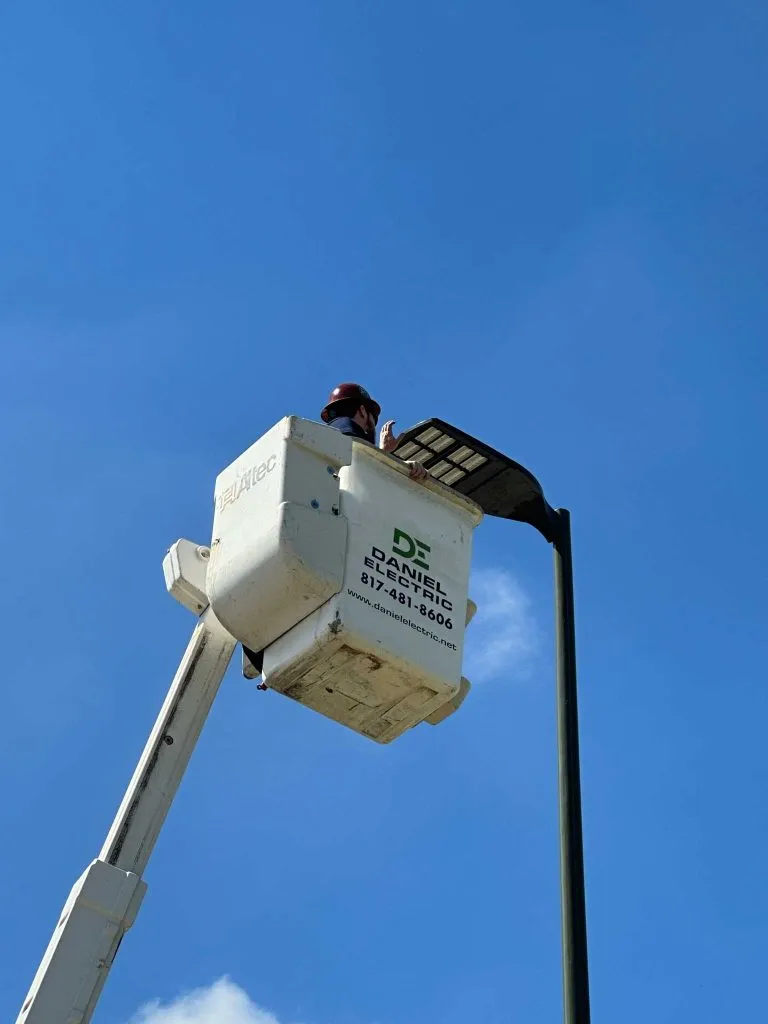
- Light pole
- A light pole is the tall post that holds parking lot or street fixtures, with wiring inside and a power feed to the fixture.
- Load calculation
- A load calculation adds up the power a building's lights, outlets and appliances may draw, so the service and circuits can be sized correctly.
- Load center
- A load center is the residential name for a distribution panel that holds circuit breakers. Product listings and catalogs use this term.
- Load management
- Load management is a control system that limits or shifts power use so several loads, such as EV chargers, stay within the capacity of a circuit or panel.
- Lumen
- A lumen is the unit that measures how much visible light a bulb or fixture gives off, which tells you its brightness.
M
- Main breaker
- The main breaker is the large breaker that shuts off all power to the panel and the circuits it feeds.
- Master electrician
- A master electrician holds the top individual electrician license in Texas, earned with years of supervised experience and an exam.
- Meter base
- A meter base, also called a meter socket, is the weatherproof box on the outside wall that holds the utility meter.
N
- NACS
- NACS is the North American Charging Standard, a compact connector first developed by Tesla and now standardized as SAE J3400.
- NEC
- The NEC, or National Electrical Code, is the model rule book for safe electrical installation, published by NFPA and updated every three years.
- NEMA 14-50
- A NEMA 14-50 is a four-prong, 240 volt, 50 amp outlet, common for RVs, that some EV owners use to plug in a charger.
- NEMA 6-50
- A NEMA 6-50 is a three-prong, 240 volt, 50 amp outlet with no neutral, used for welders and by some plug-in EV chargers.
- Neutral
- The neutral is the conductor that carries current back to the panel to complete a circuit. It is intentionally grounded at the service.
- NFPA 70
- NFPA 70 is the official standard number of the National Electrical Code, which NFPA publishes and revises every three years.
- NFPA 70B
- NFPA 70B is the standard for electrical equipment maintenance, covering planned upkeep of electrical systems in buildings and plants.
- NFPA 70E
- NFPA 70E is the standard for electrical safety in the workplace, covering safe work practices around energized equipment.
- NM-B cable
- NM-B is nonmetallic-sheathed cable: insulated wires inside a plastic jacket, widely used for wiring inside homes.
- Nuisance tripping
- Nuisance tripping is when a breaker shuts off a circuit again and again with no obvious fault, often tied to arcing, moisture or a device on the circuit.
O
- Occupancy sensor
- An occupancy sensor switches lights on when it detects people in a space and turns them off after a set time with no motion.
- Oncor
- Oncor is the regulated utility that owns and runs the poles, wires and meters that deliver power to much of North Texas.
- Outlet
- In everyday talk an outlet is a wall socket. In code, an outlet is any point on the wiring where current is taken to power equipment.
- Overload
- An overload is too much current for a circuit's wire or equipment rating. It heats the wire and can trip a breaker.
P
- Panelboard
- A panelboard is a distribution panel with buses and overcurrent devices, set in a cabinet on a wall. The term is common in commercial work.
- Photocell
- A photocell is a light sensor that turns exterior lights on at dusk and off at dawn.
- Pigtail
- A pigtail is a short length of wire used to join one or more wires to a device or to extend a wire so it can reach a connection.
- Point-of-use surge protector
- A point-of-use surge protector is a plug-in strip or outlet that protects the devices connected to it. It is the last line of defense.
- Portable generator
- A portable generator is a movable, engine-driven unit that makes temporary power for lights, tools and appliances, with carbon monoxide and backfeed risks.
- Power outage
- A power outage is a loss of electric service, caused either by a problem on the utility's lines or by a problem inside your own home.
- PVC conduit
- PVC conduit is rigid plastic tubing that protects wire. It is used outdoors and underground because it does not rust.
R
- Receptacle
- A receptacle is the formal name for the socket in the wall that a plug fits into.
- Recessed lighting
- Recessed lighting, also called can lights or downlights, are fixtures set into the ceiling so that only the trim shows.
- Relamp
- To relamp is to replace the lamps (bulbs) in a fixture or building, either all at once on a schedule or one at a time as they fail.
- Retrofit
- A retrofit upgrades an existing fixture or lamp type, such as swapping older lighting for LED, without rebuilding the whole system.
- Romex
- Romex is a brand name for NM-B cable, the plastic-jacketed cable used for most branch circuits inside homes.
S
- Service drop
- A service drop is the set of overhead wires that run from the utility's last pole to a building.
- Service entrance
- The service entrance is where utility power enters a building, along with the conductors and equipment that bring it to the main panel.
- Service lateral
- A service lateral is the underground line, sometimes run in conduit above ground, that carries utility power to a building.
- Service mast
- A service mast is the rigid pipe that rises above the roofline to hold the overhead service wires at a safe height.
- Service upgrade
- A service upgrade raises the amount of power a building can draw from the utility, usually with a new panel, meter base and service wires.
- Short circuit
- A short circuit is an unintended low-resistance path between conductors that sends a very large surge of current through the circuit.
- Smart switch
- A smart switch replaces a regular wall switch and adds wireless control, so lights respond to an app or a voice assistant.
- Smoke alarm
- A smoke alarm is a device that senses smoke and sounds a loud alarm so people in a home can get out.
- Splice
- A splice is a joint where two or more wires are permanently joined so that current can pass from one to the other.
- Stab-Lok
- Stab-Lok is the brand name for the circuit breakers Federal Pacific Electric made for its residential panels.
- Standby generator
- A standby generator is a permanently installed generator that starts on its own or on command to power selected circuits during an outage.
- Subpanel
- A subpanel is a smaller panel fed from the main panel. It adds circuits in a garage, shop or addition without a second utility service.
- Surge
- A surge is a short spike in voltage above the normal level. It can damage or wear out electronics and appliances.
- Surge protective device
- A surge protective device (SPD) is the formal name for a surge protector. It diverts extra voltage away from connected equipment.
- Switch box
- A switch box is the enclosure in the wall that holds a switch and the wire ends behind it.
- Switchgear
- Switchgear is large commercial equipment that houses breakers, switches and relays used to control, protect and isolate power.
T
- Tamper-resistant receptacle
- A tamper-resistant receptacle has built-in shutters that block objects pushed into the slots. It protects children from shock.
- TDLR
- TDLR is the Texas Department of Licensing and Regulation, the state agency that licenses electricians and electrical contractors.
- Tenant finish-out
- A tenant finish-out is the build-out of a leased commercial space, including walls, lighting, outlets and other work to suit the tenant.
- Thermal imaging
- Thermal imaging uses an infrared camera to find hot spots on electrical equipment, such as loose or overloaded connections.
- Three-phase power
- Three-phase power uses three alternating currents offset in time, giving smoother power for large motors and commercial equipment.
- Three-prong outlet
- A three-prong outlet is a grounded receptacle with a round ground slot beside the two flat slots.
- Three-way switch
- A three-way switch is one of a pair of switches that control the same light from two places, such as both ends of a hall.
- Transfer switch
- A transfer switch moves your home's circuits between utility power and a generator, and keeps the two sources apart.
- Transformer
- A transformer is a device that changes electric voltage from one level to another, such as from the lines on the street to service voltage.
- Tripping
- Tripping is when a circuit breaker automatically switches off to stop current flow after an overload, short circuit or ground fault.
- Type 1 SPD
- A Type 1 SPD installs before or at the main breaker panel, where it can stop outside surges from lightning or utility switching.
- Type 2 SPD
- A Type 2 SPD installs on the load side of the main breaker, at the panel, to protect against internal surges and leftover surge energy.
U
- Ungrounded outlet
- An ungrounded outlet is a two-slot outlet with no ground contact. It is common in older homes.
- USB outlet
- A USB outlet is a wall outlet with built-in USB ports, so phones and tablets can charge without a plug-in adapter.
V
- Voltage
- Voltage is the electrical pressure that pushes current through a circuit. U.S. homes are commonly served at 120/240 volts.
- Voltage drop
- Voltage drop is the loss of voltage along a wire as current flows through it. It grows with longer runs, higher current and thinner wire.
W
- Wattage
- Wattage is how much power a device uses at one moment, measured in watts. One kilowatt equals 1,000 watts.
- Weather-resistant receptacle
- A weather-resistant receptacle is an outlet made for damp or wet locations, such as patios, decks and pool areas.
- Weatherhead
- A weatherhead is the curved cap at the top of a service mast. It keeps rain out of the conduit where the service wires exit.
- Whole-house generator
- A whole-house generator is a permanently installed, engine-driven unit that powers part or all of a home's circuits when utility power fails.
- Whole-house surge protector
- A whole-house surge protector is a surge protective device installed at the electrical panel to guard every circuit in the home.
- Wire gauge
- Wire gauge is a number for wire thickness. In the American system, a smaller number means a thicker wire.
- Wire nut
- A wire nut is a twist-on connector with an insulated cap that holds two or more stripped wire ends together inside an electrical box.
TECL #21005 · Family owned since 1988
Need an electrician in Southlake?
Call and tell us what is going on. A photo of the panel label or the problem helps us come prepared. Quotes on new installations are free.