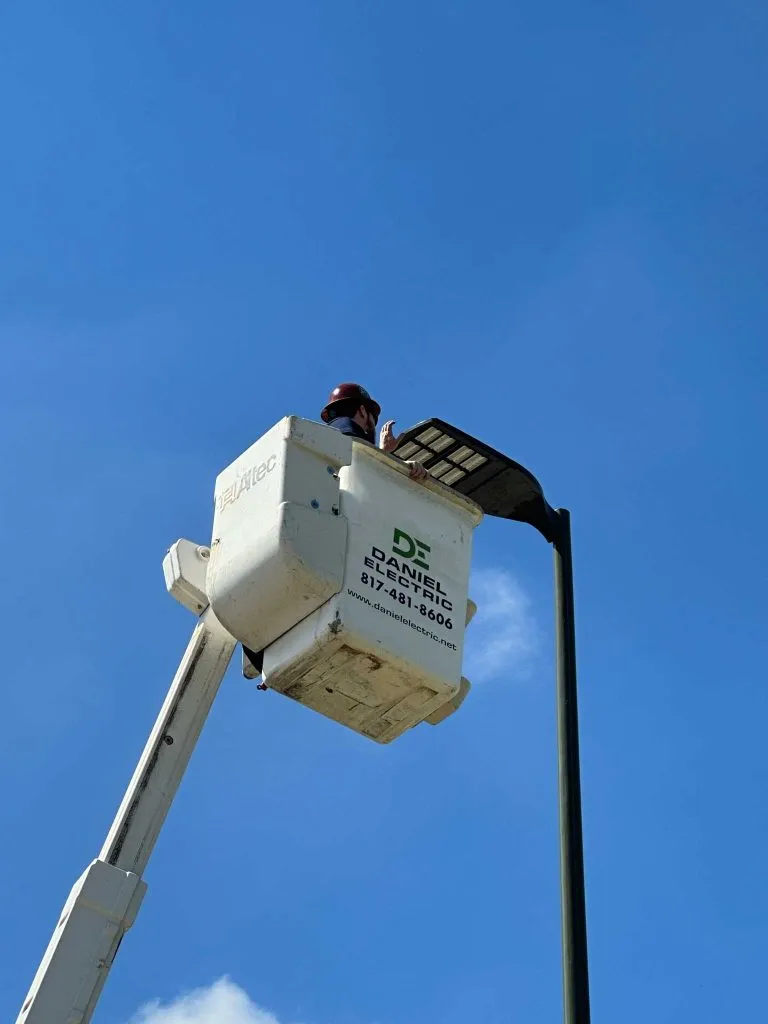
What residential electrical services does Daniel Electric offer?
Daniel Electric’s site lists residential repairs and upgrades, and these specific jobs: pool electrical repair, TV installation, underground circuits, hot tub installation, ceiling fan installation, surge protection, breaker panel replacement, arc fault breaker installation, CSST gas line bonding and service upgrades.
The company is family owned and operated, based in Southlake, and says it has served the area since 1988. It states that its electricians are drug and background tested, that it gives free quotes on new installations, and that it handles both residential and commercial work.
Here is how those jobs group together, and where to read more.
| Group | Jobs on our site | Read more |
|---|---|---|
| Repairs and troubleshooting | Finding faults, fixing outlets, switches and circuits | The emergency and troubleshooting pillar |
| Panels and service | Breaker panel replacement, service upgrade, Federal Pacific panel removal | The panels and service upgrades pillar |
| Protection | Surge protection, arc fault breakers, smoke and CO detectors, CSST gas line bonding | The surge protection and safety pillar |
| Lighting and fans | Fixtures, ceiling fans, TV installation | The lighting pillar |
| Outdoor and water | Pool electrical repair, hot tub installation, underground circuits | This page, and the lighting pillar |
| Chargers | EV charging station installation | The EV charger pillar |
Our site says that if you have a Federal Pacific breaker panel, the company will remove it to prevent electrical fires. We explain the facts behind that in the panel pillar, including what the Consumer Product Safety Commission found and what it did not.
For a panel, a service upgrade or a new large load, start with electrical panels and service upgrades. For a fault, a smell, a trip or an outage, start with emergency electrical help and troubleshooting.
When should I call an electrician?
Call when you see a sign that your wiring is under stress, or when a job reaches inside a panel, a box or a fixture. NFPA lists tripping breakers, warm or discolored outlets, a burning smell and flickering or dimming lights as reasons to call a qualified electrician.
ESFI states that electrical distribution systems are the third leading cause of home structure fires. That is why a small recurring problem matters. Here is a quick guide.
| Symptom | Call now? | Notes |
|---|---|---|
| Breaker trips again and again | Yes, soon | Do not keep resetting it |
| Outlet or switch plate is warm or brown | Yes, stop using it | Heat means a bad connection or overload |
| Burning or rubbery smell | Yes | If smoke or flame, call 911 |
| Lights flicker or dim | Yes, if it repeats or covers several rooms | One bulb may be only a bulb |
| Buzzing or sizzling from an outlet or panel | Yes | Keep clear of the panel |
| A tingle from an appliance | Yes | Unplug it and have it checked |
| Dead outlets in one room | Yes, after a simple check | Check GFCI reset and breakers first |
| You want a new circuit, fan or hot tub | Yes | Plan the load first |
These are signs, not a diagnosis. A licensed electrician finds the cause in person.
Some jobs belong to the homeowner. Replacing a bulb, pressing a GFCI reset button and checking a smoke alarm battery are safe tasks. Rewiring a switch, extending a circuit and working in a panel are not.
What fan, TV, pool and hot tub jobs involve special care?
Ceiling fans, TV mounts, pools and hot tubs each have a special rule. A fan needs a fan-rated box. A TV may need a power outlet behind it. Pool and hot tub wiring has strict rules about distance, protection and bonding. Call a licensed electrician for all of them.
Ceiling fans. A fan shakes, and the box must be rated to carry its weight and motion. A box made for a light may not hold a fan. A fan also needs a switch plan, such as a wall control or a remote, and the right circuit.
TV and appliance installation. Daniel Electric’s lighting page lists TV, refrigerator and oven installation. A wall-mounted TV often needs power and cable lines behind the wall. Cutting into a wall without knowing what is inside is a risk. An electrician can add an outlet behind the screen and route the wiring in a code-compliant way.
Pool and hot tub work. Water raises the risk of shock, so the rules for distance, ground-fault protection and bonding are strict. A hot tub is a large load and often needs its own circuit. The panels pillar explains how capacity works.
Underground circuits. Power to a detached garage, a pool pump, a gate or yard lighting often runs underground. The cable type, depth and protection all matter. Call before you dig, and let a licensed electrician plan the route.
Arc fault breakers. An arc fault breaker senses dangerous arcing in wiring and trips. NFPA says that if AFCIs are not installed in your home, you should ask a licensed electrician to install them for your safety. See the AFCI entry in our glossary.
CSST gas line bonding. Flexible gas piping needs a proper bond to the grounding system. It is a job for a licensed electrician. Ask us what your home needs.
What electrical checks make sense when I buy, sell or remodel?
Check the panel, the grounding, the outlets, the smoke and CO alarms and the age of the wiring. A look before a sale or a remodel can find problems while you still have time to plan. A licensed electrician should do the inspection, not a guess from the listing.
For a buyer, an electrical check answers: is this house safe, and what will it need soon? For a seller, it answers: what will a buyer’s inspector flag? For a remodel, it answers: can the panel carry what we plan to add?
A short checklist:
- Panel. Brand, age, rating, damage, space and labels.
- Service. Meter base, mast and the wires to the house.
- Wiring. Type and condition, including any aluminum or cloth-covered wiring.
- Grounding and bonding. Is the system tied to ground correctly?
- Protection. GFCI and AFCI where they belong, and a surge device at the service.
- Alarms. Smoke and CO alarms on every level and outside bedrooms.
- Outdoor and wet areas. Weather-rated gear and ground-fault protection.
- Load. Does the service fit the loads, and the loads you plan to add?
Ask for a written list of findings with photos. If the list shows an urgent item, ask for it to be marked clearly. A remodel permit may also require an electrical inspection, so ask your city.
How do I check a license, and what should I ask?
Check the contractor’s license on the TDLR website before you sign. TDLR states that anyone who performs or offers to perform non-exempt electrical work in Texas must be licensed and perform that work through a licensed electrical contractor. Then ask a short list of questions.
A master electrician and a journeyman electrician hold different licenses, and a licensed electrical contractor holds a business license. Ask who will be at your home, and which license covers the work. Our guide on how to hire a licensed electrician in Texas explains the license types.
Ask these questions of any electrician, ours included.
| Question | Why it matters |
|---|---|
| What is your license number? | You can check it on TDLR. Ours is TECL #21005. |
| Who will do the work? | You want to know who is in your home. |
| Is the quote in writing, and what does it include? | The scope should list the permit, the inspection, the parts and the cleanup. |
| Who pulls the permit? | Unpermitted work can cause trouble at a sale or an insurance claim. |
| What does the warranty cover? | Read the written terms before work starts. |
| How do you screen your crews? | Daniel Electric states that its electricians are drug and background tested. |
| What happens if the inspector asks for a change? | You should know before the job starts. |
Cities add rules on top of the state license. The City of Southlake, for example, says trade contractors with a current state license must register with the city. Ask your city or your electrician what applies at your address.
What about doing my own electrical work?
The Texas licensing law exempts some work done by an owner in the home where they live, if a city ordinance does not regulate it. Cities add their own rules. Flower Mound, for example, says homesteaded owners can do their own electrical work, but a permit may be required and the work must comply with the Town’s adopted code.
A legal exemption is not the same as safe work. Electrical mistakes can cause shock and fire, and the harm may not show for months. If you plan to do work yourself, check your city’s permit rules first, and ask yourself if you have the skills and the tools to do it safely.
Our rule is simple. Replace a bulb. Reset a GFCI once. Test an alarm. For anything inside a panel, a box or a fixture, call a licensed electrician.
Code editions change too. TDLR adopted the 2026 National Electrical Code as the state electrical code, effective September 1, 2026. Many city pages still list an older edition. Ask your city or electrician what applies on the day of your permit.
Which cities do you serve?
Daniel Electric is based in Southlake, and its site lists service to Grapevine, Colleyville, Keller and the surrounding DFW area. The service areas page lists each city and links to local pages with permit and utility notes.
Each city has its own permit office, code edition and registration rules. Utilities also differ. Oncor serves much of the area, and Tri-County Electric Cooperative and CoServ serve parts of it. Look at your bill to see who sends it.
See the service areas page for the full list. If your city is not on the list, call (817) 481-8606 and ask.
What does the first visit look like?
The first visit is a conversation and a look. The electrician asks about the problem, looks at the panel and the affected circuits, explains what they find and gives a written scope. You should leave knowing what is wrong, what the options are and what each one covers.
Prepare for it.
- Write down the symptoms, when they began and where they appear.
- Take photos of the panel label with the door closed, and of any damaged outlet or fixture.
- List any new equipment you plan to add.
- Know your utility, and have your last bill handy.
- Clear a path to the panel and to the work area.
- Note any pets or access limits.
Daniel Electric states that it gives free quotes on new installations. Ask for the permit, the inspection and the warranty terms in the written scope. Read the terms on the warranty page before work starts.
How can I keep my home’s electrical system in good shape?
Test your safety devices, fix small problems early, and keep a short record of work done. A yearly look at the panel and the outdoor equipment is a good habit in an older home. Know where your main breaker is and how to turn it off.
Use this list.
- Test smoke and CO alarms every month, and replace them on the maker’s schedule.
- Press the test button on each GFCI and AFCI on the schedule the maker gives.
- Avoid overloading outlets, and do not run cords under rugs or through walls.
- Replace outlets and cords that feel warm or look damaged.
- Add a whole-house surge protective device.
- Keep records of permits, inspections and warranty papers.
Our home electrical safety checklist turns this into a room-by-room walk.
Next step
To plan a repair, an upgrade or an installation, see our residential electrician page. Call (817) 481-8606 or send the quote form, and tell us what you see and where.
Frequently asked questions
What does a residential electrician do?
A residential electrician finds and fixes electrical faults and installs new equipment in homes. Daniel Electric's site lists repairs and upgrades, panels and service upgrades, surge protection, ceiling fans, TV installation, pool and hot tub electrical, underground circuits, arc fault breakers and CSST gas line bonding.
How do I check that an electrician is licensed in Texas?
Use the license lookup on the TDLR website and search the contractor's name or license number. TDLR states that anyone doing non-exempt electrical work in Texas must be licensed and work through a licensed electrical contractor. Daniel Electric's license is TECL #21005.
Can I do electrical work in my own home in Texas?
The Texas licensing law exempts some work a homeowner does in the home where they live, if a city ordinance does not regulate it. Cities add their own rules, such as permits and registration, so ask your city first. Never work inside a panel or on live wiring without the skills and a permit if needed.
When should I call an electrician instead of fixing it myself?
Call for anything inside a panel, an outlet box or a fixture, for repeated breaker trips, warm outlets, burning smells, buzzing, flicker you cannot trace and any job that adds a circuit. Replacing a bulb is a homeowner task. Rewiring a fixture or a switch is not.
Does Daniel Electric give free quotes?
Daniel Electric states that it gives free quotes on new installations. Call (817) 481-8606 or use the quote form on the contact page. Ask for the scope in writing, with the permit, the inspection and the warranty terms, so you can compare it with any other quote.
What areas does Daniel Electric serve?
Daniel Electric is based in Southlake and serves Grapevine, Colleyville, Keller and many nearby DFW cities. The service areas page lists the cities and links to city pages with local permit and utility notes. Call (817) 481-8606 if your city is not listed.
Terms on this page
Sources
- TDLR: Electricians
- Texas Occupations Code Chapter 1305
- TDLR: Commission adopts rules (2026 National Electrical Code)
- NFPA: Electrical Home Fire Safety
- ESFI: Home Electrical Fires
- City of Southlake: Building Inspections and Code Enforcement
- City of Flower Mound: FAQs
Written by Daniel Electric and checked against the sources above on October 21, 2026. City rules and product guidance change, so check the linked page before you act.