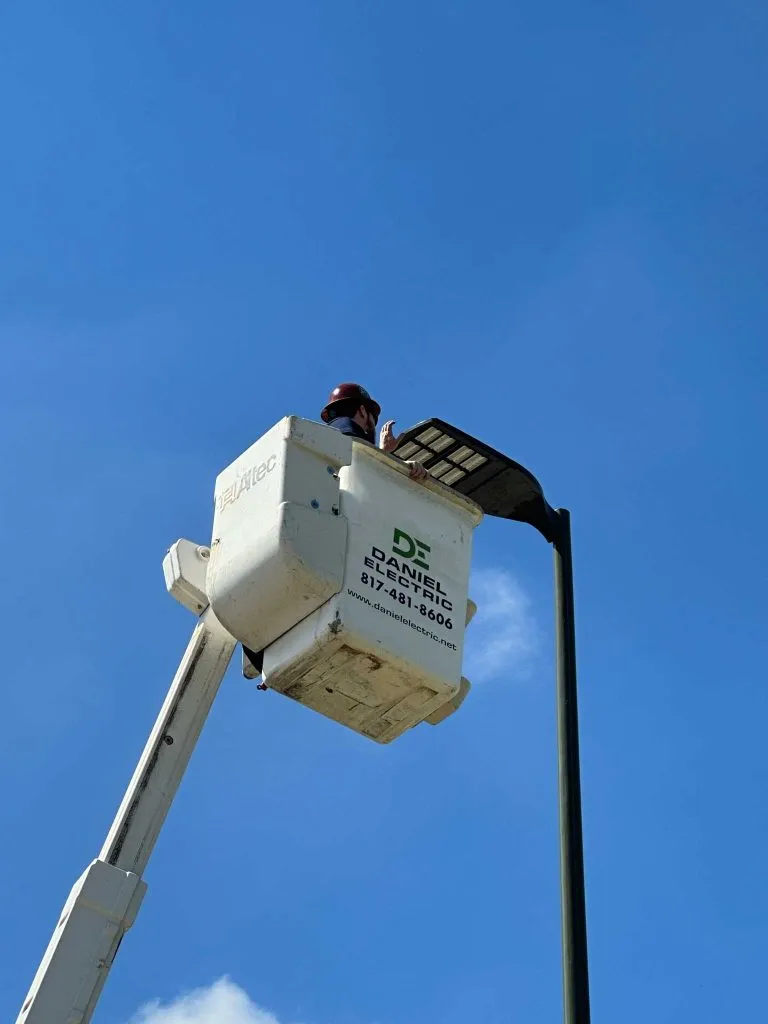
Why do parking lot lights stop working?
Parking lot lights fail for a short list of reasons: a bad photocell, a failed driver or ballast, a dead lamp or LED module, a damaged fixture, a tripped breaker, or broken wiring. The pattern of the outage tells you where to start. One pole out points to that fixture. A full row out points to a shared circuit or control.
Use this table to narrow the cause before you call anyone.
| What you see | Likely cause | Who fixes it |
|---|---|---|
| One pole dark, others fine | Lamp, LED module, driver or ballast in that fixture | Electrician |
| Lights stay on in daytime | Failed photocell or stuck control | Electrician |
| Lights never come on at night | Photocell, breaker, contactor or timer | Electrician |
| A whole row or zone dark | Tripped breaker, shared circuit fault, or damaged underground wiring | Electrician |
| Lights flicker or cycle on and off | Failing driver or ballast, loose connection, or a failing photocell | Electrician |
| Knocked-over or leaning pole | Vehicle impact, rusted base, or loose bolts | Electrician and, for the pole, a qualified pole contractor |
Do not open fixtures, pole bases or junction boxes yourself. These can hold live power, and many poles are damaged in ways you cannot see from the ground.
What are the main parts you may hear about?
- Photocell: the light sensor that switches the fixture at dusk and dawn.
- Ballast: a part in older fixtures that starts and regulates the lamp.
- LED driver: the power supply in an LED fixture. When it fails, the light goes dark or flickers.
- Fixture or luminaire: the housing, optics and lamp or LED array.
- Light pole: the mast that carries the fixture, with a wiring compartment at the base.
- Circuit: the wiring and breaker that feed a group of poles, often underground.
Should I repair, replace or retrofit?
Repair a single failed part. Replace a fixture that is damaged, keeps failing, or has parts that are hard to find. Retrofit to LED when many aging fixtures need work and you want a planned, lasting fix instead of repeated call-outs. The right answer depends on how many fixtures are affected and how old they are.
Here is a simple way to compare.
| Option | Best when | Trade-off |
|---|---|---|
| Repair | One part failed; the fixture is otherwise sound | Fast, but the next failure may be close behind on old fixtures |
| Replace the fixture | Housing is cracked, water got in, or it fails again and again | Costs more than a part, solves a repeat problem |
| Retrofit to LED | Many fixtures are aging, or you want better light quality | Needs planning, a lighting layout check and a quality product |
| Replace the pole or circuit | Poles are rusted, hit, or underground wiring is damaged | The largest scope; may need permits and trenching |
We do not state prices. Cost depends on the number of poles, fixture type, pole height, access, wiring condition and permits. A site visit is the only honest way to scope it. Daniel Electric lists free quotes on new installations.
How do I know it is a repeat problem?
Keep a log. Write down the pole, the date, the symptom and the repair. If the same pole shows up twice, the cause is probably not the part you replaced. It may be a wiring fault or moisture in the base. A log turns guesses into a pattern.
What should I know about LED retrofits?
A well-designed LED retrofit can give the light you need with less energy and better uniformity. The U.S. Department of Energy says so about well-designed LED outdoor luminaires compared to older metal halide and high-pressure sodium sources. DOE also says LED product quality varies, so careful selection matters. Treat the product and the layout as part of the job.
Note that the DOE fact sheet we cite is an older publication. LED technology has changed since then. Use it for the questions to ask, not for specs.
Ask these questions about any LED proposal.
- Which fixtures, and from which maker? Ask for the model, not only the brand.
- What is the layout? Poles stay where they are, but the light spread of new fixtures can differ from the old ones. Ask whether the plan checks how evenly the lot is lit.
- What is the warranty? Get the maker’s warranty and the installer’s warranty in writing. See the warranty page for Daniel Electric’s terms.
- How is glare and spill-over controlled? DOE’s fact sheet discusses glare, light trespass and sky glow as design concerns. Neighbors notice.
- Is the existing wiring ready? Old circuits, photocells and controls may need work too.
- What happens to the old fixtures? Ask the installer to handle removal.
If you want LED lights without a full parking lot project, see our LED lighting installation page. For a broader view of lighting choices, read our pillar guide on lighting installation and LED retrofits.
What do lumens and color temperature mean here?
A lumen is a measure of light output. Color temperature describes how warm or cool the light looks. A cooler, whiter light is often used for visibility and cameras. A warmer light can feel gentler to neighbors. Your electrician can show samples on site.
What safety and liability issues should owners think about?
Dark parking lots are a safety concern for customers, tenants and employees. Owners and managers should fix outages promptly and keep records. Ask your own attorney or insurer about legal duties for your property. This guide cannot advise on liability.
Good practice looks like this:
- Walk the lot after dark on a regular schedule.
- Log each outage with date, pole and symptom.
- Report damaged poles and exposed wiring right away.
- Put barriers or cones around any pole base that is open or damaged.
- Keep people and vehicles away from a leaning pole.
- If you see a downed wire, stay away and call 911 and the utility.
Why must a licensed electrician do the work?
Pole wiring and parking lot circuits carry power that can hurt or kill. Electricians de-energize circuits and lock them out before work. OSHA says proper lockout/tagout practices safeguard workers from hazardous energy releases. Texas also requires that non-exempt electrical work be done by licensed people working through a licensed electrical contractor. Our guide on hiring a licensed electrician in Texas shows how to check.
Do parking lot lighting changes need permits or utility steps?
Possibly. Like-for-like repairs may not need a permit. New poles, new circuits, and changes to wiring often do. Rules differ by city. Ask your electrician which city rules apply, and check the city’s building page. Some lots also have lighting rules in the city code, such as limits on glare or spill-over.
Utilities matter when service changes. If a project changes the electrical service, the local utility may need to take part. In this area, Oncor serves many customers. Co-ops serve others. Your electrician can sort out who owns what.
Ask the electrician early about these points:
- Does the scope need a permit and an inspection?
- Will any power outage be needed, and for how long?
- Will work happen after hours to keep the lot open?
- Who restores the paving or landscaping if trenching is needed?
How do I keep parking lot lighting working?
A simple maintenance routine prevents most surprises. Walk the lot at night. Log every dark fixture. Have an electrician inspect poles, bases, controls and circuits on a schedule. Replace aging parts before they fail. Pair this with a wider commercial electrical maintenance plan for the whole facility.
| Task | Who | How often |
|---|---|---|
| Night walk, note dark or flickering lights | Property staff | Regularly, such as monthly |
| Check pole bases and covers for damage or moisture | Electrician | During scheduled visits |
| Test photocells and controls | Electrician | During scheduled visits |
| Inspect circuits, breakers and connections | Electrician | During scheduled visits |
| Review the outage log for repeat failures | Property manager and electrician | Quarterly |
Ask your electrician to suggest a schedule that fits your site, your fixtures and your tenants.
What does Daniel Electric do for parking lot lighting?
Daniel Electric lists parking lot lighting repair and replacement as a service. Its page names running new pulls, repairing light poles, installing energy-efficient parking lot lighting, and troubleshooting electrical and lighting issues. The company is family owned and operated and says it has served the area since 1988. For other commercial work, see our commercial electrician page.
Next step
See our parking lot lighting repair page, then call Daniel Electric at (817) 481-8606 or send details through the quote form at /contact.
Frequently asked questions
Why is my parking lot light not turning on?
Common causes are a failed photocell, a bad driver or ballast, a dead lamp or LED module, a tripped breaker, or damaged wiring. A whole row out at once points to a shared circuit or control. A single pole out points to that fixture. A licensed electrician should trace it.
Should I repair or replace a parking lot light?
Repair when one part failed and the rest of the fixture is sound. Replace when the fixture is damaged, the same pole keeps failing, or parts are hard to find. If many fixtures are old, a planned retrofit can be more practical than repeated one-off repairs.
Are LED parking lot lights worth it?
DOE says well-designed LED outdoor luminaires can provide the needed light with less energy and better uniformity than older metal halide and high-pressure sodium sources. DOE also warns that LED product quality varies by manufacturer, so choose carefully. Ask an electrician what suits your lot.
What does a photocell do in a parking lot light?
A photocell is a light sensor. It turns the fixture on at dusk and off at dawn. When it fails, lights may stay on all day, never come on, or flicker. It is often a quick fix, but confirm it is the cause before you replace it.
Do I need a permit to change parking lot lighting?
It depends on the city and the scope of work. Like-for-like repairs may not need one, while new poles, new circuits or changed fixtures often do. Check with your city's building department, and ask your electrician who will handle permits.
How often should parking lot lights be checked?
There is no one schedule for every site. A regular walk of the lot after dark, plus a periodic inspection by an electrician, catches problems early. A common approach is a monthly night walk with a log of dead fixtures, dates and repairs.
Terms on this page
Sources
- U.S. Department of Energy: LED Application Series, Outdoor Area Lighting
- U.S. Department of Energy: LED Application Series, Outdoor Area Lighting (efficiency)
- OSHA: Control of Hazardous Energy (Lockout/Tagout)
Written by Daniel Electric and checked against the sources above on October 21, 2026. City rules and product guidance change, so check the linked page before you act.