What lighting do we install indoors?
We handle fixture installation, recessed lighting, ceiling fans, switches, dimmers and indoor repairs. Daniel Electric’s lighting page also lists TV, refrigerator and oven installation among its lighting and appliance work. Each job starts with the circuit, the box and the load.
A light that looks simple is a small system. It has a power source, a switch, a connection, a fixture and a bulb or module. Each part must fit the others. The main indoor jobs look like this:
| Job | What it involves | What to settle first |
|---|---|---|
| Replace a fixture | Remove the old one, connect and mount the new one | Is the box strong enough, and is the wiring in good shape? |
| Add recessed lights | Cut openings, run wire, set housings, connect to a switch | Ceiling type, insulation contact, spacing, light level |
| Install a ceiling fan | Mount a fan-rated box, connect fan and light | The box must be rated for fan weight and motion |
| Add or change switches and dimmers | Replace or add control | Dimmer must match the lamp type |
| Add a circuit for a new load | New breaker and wire | Panel space and capacity |
| Repair an indoor light problem | Trace the fault, fix the connection or part | Cause, not just symptom |
Recessed fixtures need extra care. Housings that touch insulation need the right rating. The opening must fit the ceiling. The spacing sets the look. Ask the electrician to show a layout and to mark the ceiling before cutting.
Ceiling fans deserve a special note. A fan shakes, so the box must be listed for fan support. A box meant for a light fixture may not hold a fan. Do not hang a fan from an ordinary box.
What about outdoor and security lighting?
Outdoor lighting has to survive weather, so the equipment, the connections and the wire route all matter. Daniel Electric’s lighting page lists landscape lights, security lights, and pool and hot tub lighting among the work it handles. Describe your site when you call.
Four things set an outdoor job apart from an indoor one.
- Moisture. Outdoor fixtures, boxes and covers must be made for wet or damp places. A fixture that is fine in a hallway can fail on a porch.
- Wire route. Underground and exterior runs need the right cable and the right depth and protection. Never dig without calling for a utility locate first.
- Control. Photocells, timers and motion sensors turn lights on and off. Pick the control for how you use the space.
- Aim and glare. Security lights should light the area and not your neighbor’s window. A shield or a new angle often fixes it.
Pool and hot tub areas have stricter rules than a patio. Water and electricity are a bad mix, and the code sets distances and protection for good reason. Call a licensed electrician for any light, outlet or equipment near a pool or spa.
What changes in an LED retrofit, and what stays the same?
An LED retrofit replaces an older light source with an LED one. The wiring, the switch and the fixture location often stay the same. The lamp, the driver and sometimes the whole fixture change. The Department of Energy says top-performing LEDs consume 80% less energy than traditional incandescent bulbs.
An LED retrofit takes one of three forms.
| Type | What changes | Good fit |
|---|---|---|
| Lamp swap | Only the bulb or tube | The fixture is sound and takes an LED lamp |
| Retrofit kit | New LED module in the old housing | The housing is good but the light source is worn |
| Fixture replacement | The whole fixture | Old fixtures with failing parts, or a new look |
Know three terms. A lumen measures how much light a lamp gives off, and it is a better guide than watts. Color temperature, in kelvins, tells you if the light looks warm or cool. A driver is the part that converts line power to the low-voltage direct current an LED needs. A bad driver is often the cause when an LED fixture flickers or fails.
The Department of Energy also notes that LED sources are inherently dimmable and can be integrated with sensors and controls. That is why LED retrofits often pair with occupancy sensors, timers and dimmers. Those controls can add energy savings, and they raise the question of compatibility, which is the next section.
What stays the same: the circuit has to be in good condition. An LED retrofit does not fix a loose connection or an overloaded circuit. Fix the wiring first, then upgrade the light.
Will my dimmers work with LED lights?
Maybe not. Dimmers made for older bulbs often do not work well with LED lamps. The result can be flicker, buzz, a narrow range or lights that will not turn all the way off. Match the dimmer to the lamp, and test before you buy a full set.
A dimmer switch controls the power sent to the light. LEDs respond differently from older bulbs. They draw much less power, and their electronics react to how the dimmer cuts the wave. Here is how to avoid trouble.
- Read the lamp package or manual for a list of compatible dimmers.
- Read the dimmer for the type of load it supports and its minimum load.
- Test one lamp and one dimmer in the room before you buy more.
- Do not mix lamp brands on one dimmer without testing.
- Ask the electrician to choose a dimmer made for LED loads.
Common dimmer symptoms and likely causes:
| What you see | Likely cause | Next step |
|---|---|---|
| Flicker at low dim levels | Dimmer and lamp mismatch | Try an LED-rated dimmer |
| Buzz from the dimmer or lamp | Mismatch or low load | Match dimmer and lamp |
| Lights glow when off | Leakage current through a control | Ask the electrician about the control |
| One light in a group flickers | A bad lamp or driver | Swap that lamp |
| Every light on the circuit flickers | Possible wiring problem | Call a licensed electrician |
The next section covers when flicker points past the bulb.
When does flickering mean a wiring problem and not a bulb?
If new bulbs and a matched dimmer do not stop the flicker, or if lights flicker or dim across the house, the cause may be a loose connection or a circuit problem. NFPA and ESFI both list flickering or dimming lights among the signs to bring in a qualified electrician.
A bulb problem usually stays with one fixture. A wiring problem tends to follow a circuit, a room or a large appliance. Use this to sort what you see:
| Pattern | More likely | Action |
|---|---|---|
| One fixture, one bulb | The bulb | Replace the bulb |
| One fixture, new bulb, still flickers | Fixture, socket or driver | Have it checked |
| Several lights on one circuit | A loose connection or circuit fault | Call a licensed electrician |
| Lights dim when the AC or dryer starts | A circuit near its limit, or a connection | Call a licensed electrician |
| Flicker plus buzzing, heat or a burning smell | A hazard | Turn off the circuit if safe, and call a licensed electrician now |
| Smoke, flame or sparks | An emergency | Leave and call 911 |
ESFI lists telltale signs of electrical problems, such as dim and flickering lights and unusual sizzling and buzzing sounds from your electrical system. Do not ignore a pattern like that. For help with the larger picture of problems and what to do first, see our pillar on emergency electrical help and troubleshooting.
Can you handle commercial relamps and retrofits?
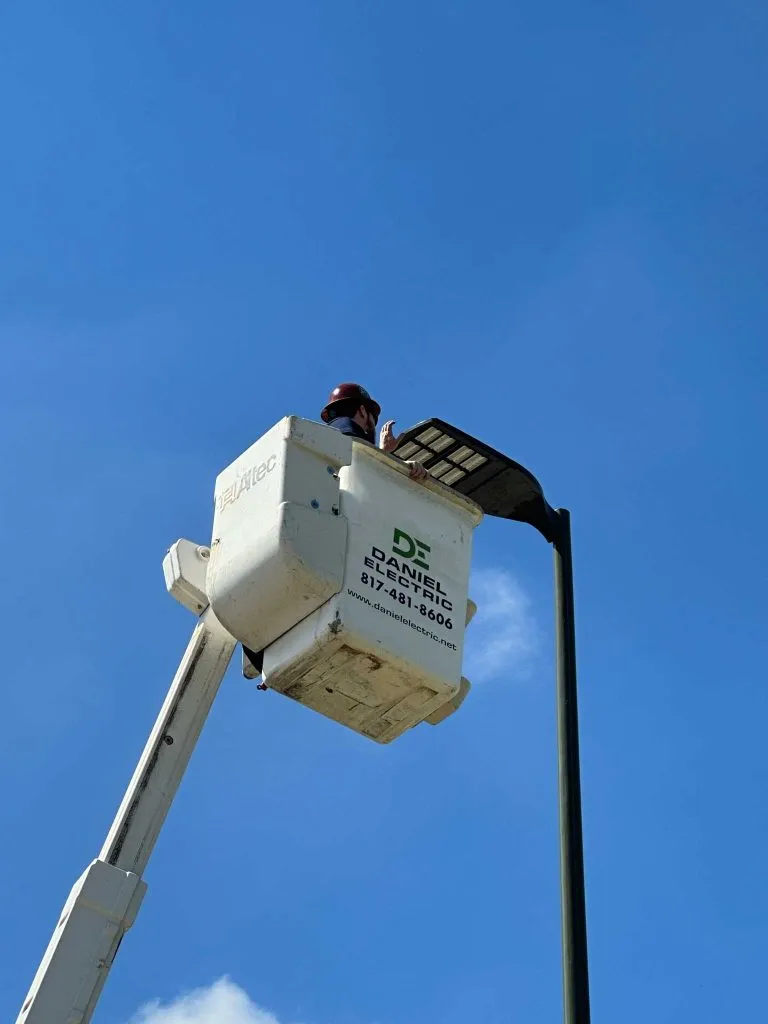
Yes. Daniel Electric’s site lists commercial lighting, parking lot lighting, and indoor relamps and retrofits among the services it handles for businesses. Tell us the building type, the fixture count and the goal, and we will plan the visit.
Commercial work has different questions than a home. Facility managers often ask these:
- Which fixtures can be retrofitted, and which should be replaced? Old fixtures with failing ballasts or housings may be better replaced.
- What is the lifespan and the maintenance plan? LED sources last, but drivers and housings can fail.
- Can we add controls? Occupancy sensors, daylight sensors and timers can add savings. The Department of Energy points to occupancy sensing, daylight harvesting and local control of light levels.
- Who handles the disposal? Old lamps and ballasts may need proper handling. Ask the electrician what applies.
- What will the work do to business hours? Plan the schedule to avoid lost time.
A ballast is the part in older fluorescent and some other fixtures that controls the current to the lamp. It is a common point of failure, and an LED retrofit may bypass or remove it. Ask the electrician how your fixtures are handled.
Parking lot and exterior lighting is its own subject. See our pillar on commercial electrical services for how we handle those jobs, and our guide on parking lot lighting repair.
How do I plan a lighting project so it comes out right?
Start with the use of each space, then pick the light level, the color and the controls. Then check the circuit. A good plan lists every fixture, every switch and every dimmer before work begins.
Walk each room with a short list.
- What happens here? Reading, cooking, working, sleeping and security each need different light.
- How much light? Use lumens as a guide, not watts.
- What color? Warm light suits living areas. Cooler light suits work areas. Keep the color the same within one room.
- What controls? Switches, dimmers, sensors and timers.
- What is on the circuit? Count the fixtures and any other loads on it.
- What is in the ceiling or wall? Insulation, joists and old wiring can change the plan.
Bring photos to the first visit. Show the ceiling, the switches and the panel label. Describe what bothers you now, such as shadows, glare, dark corners or flicker.
Ask for a written scope. It should list each fixture, each control and what is included. If you want to compare it with another quote, you will have a clear base.
What does lighting work involve for an older home?
Older homes may have wiring that does not match today’s fixtures. The boxes may be small. The wire may have cloth or brittle insulation. A new light is a good moment to check these items, and a licensed electrician should do it.
When a fixture swap uncovers a problem, the job changes. Stop and call a licensed electrician if you see any of these:
- Crumbling, cracked or cloth-covered insulation.
- Burn marks, melted plastic or a burning smell at a box.
- A box with no ground wire where one is expected.
- Aluminum-colored wire in a home built in a certain period.
- Wires that are too short to reach the new fixture.
What should I know about permits and licensing?
Texas requires a license for non-exempt electrical work. TDLR states that anyone who performs or offers to perform that work must be licensed and perform it through a licensed electrical contractor. A permit may apply to larger lighting projects, and cities set their own rules.
Simple bulb changes are not electrical work for hire. Rewiring a circuit, adding fixtures or installing a panel-fed outdoor system is. Ask your electrician if your project needs a permit, and keep a copy of any inspection record.
Daniel Electric is based in Southlake, and its Texas license is TECL #21005. Check any contractor’s license on the TDLR site before you hire.
How do I get started?
Call or use the quote form. Tell us where the lights are, what you want and what bothers you now. Daniel Electric states that it gives free quotes on new installations, and we put the scope in writing.
Daniel Electric is family owned and operated, and the company says it has served the area since 1988. Its electricians are drug and background tested, as the company states on its home page.
Next step
For fixtures, switches and outdoor lights, see our lighting installation page. For retrofits and relamps, see our LED lighting installation page. Call (817) 481-8606 or send the quote form.
Frequently asked questions
What is the difference between lighting installation and an LED retrofit?
Lighting installation adds or relocates fixtures, switches and circuits. An LED retrofit changes the light source in a place that already has lights. Some retrofits only change the lamp. Others replace the fixture or its parts. Both need a licensed electrician if the work reaches wiring.
Why do my LED lights flicker or buzz on a dimmer?
Many dimmers were made for older bulbs and do not pair well with LED lamps. Match the dimmer to the LED lamp or driver. If flicker also shows up on other circuits or with new bulbs, the cause may be a loose connection, so call a licensed electrician.
Can I install a ceiling fan or light fixture myself?
Replacing a bulb is a homeowner task. Wiring a fixture, fan or switch is electrical work inside a box, and a mistake can cause shock or fire. In Texas, licensed electricians do this work for customers. Call a licensed electrician, and do not guess about the box.
Does Daniel Electric install outdoor and security lighting?
Daniel Electric's lighting page lists landscape lights, security lights, and pool and hot tub lighting among the lighting work it handles. Call (817) 481-8606 and describe the site. We will tell you what the job needs and give a quote in writing.
Do you do commercial lighting?
Yes. Daniel Electric lists commercial lighting, parking lot lighting and indoor relamps or retrofits for businesses. Tell us the building type, the fixture count and the problem, and we will plan the visit. See the commercial electrical services pillar for how we work with facilities.
Terms on this page
Sources
- U.S. Department of Energy: LED Basics
- U.S. Department of Energy: Saving American Families and Businesses Money through Lighting Efficiency
- NFPA: Electrical Home Fire Safety
- ESFI: Home Electrical Fires
- TDLR: Electricians
Written by Daniel Electric and checked against the sources above on October 21, 2026. City rules and product guidance change, so check the linked page before you act.